
Syra Saari – Semi-Organza Saree
Fabric: Semi-organza saree woven in-house.
Look: Booti embroidery all over with finished lace borders.
Best for: Receptions and formal evenings where the pallu must hold shape.
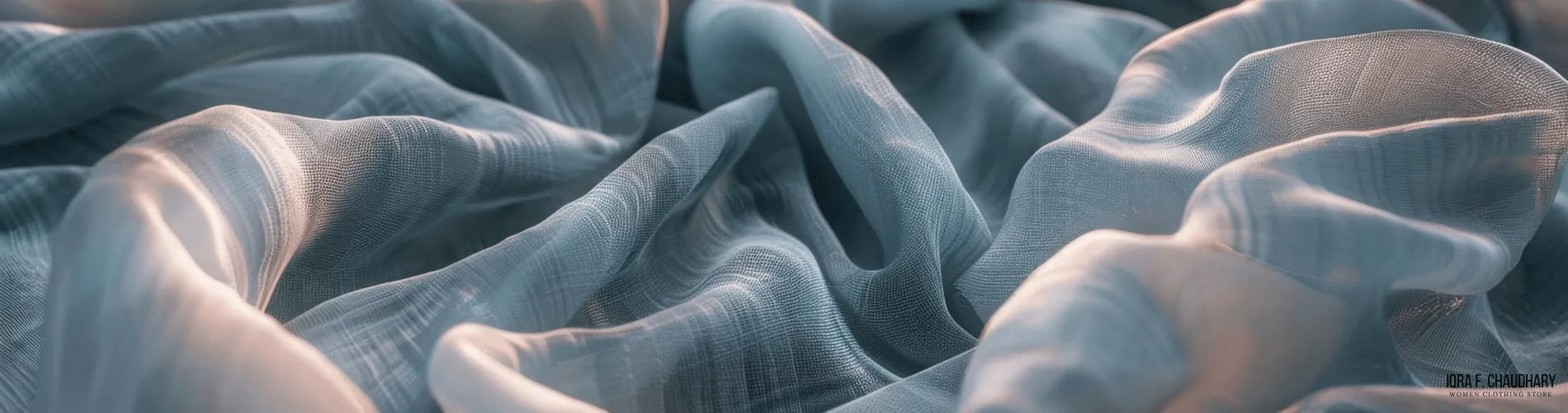
Organza fabric Is a sheer, crisp cousin of silk. I explain what it is as a material, which types exist, and how its story runs from the Silk Road up to modern semi-organza. I show how mills twist and weave the yarn, how women’s clothes use organza as outer layers, and how its physical and chemical properties sit beside silk and chiffon.
I sum up pros and cons in a table, compare organza with chiffon and silk fabric, and explain how to recognize, wash and press it with care. Then I describe Iqra F. Chaudhry(women dresses desinger brand), how she uses semi-organza in sarees, gowns and three-piece sets, list key organza outfits, note her organza saree, and close on how organza fits different events and seasons.
Organza fabric is a very lightweight, sheer, plain-weave fabric with a crisp hand, traditionally woven from silk filament and now widely produced in polyester and nylon versions. The weave uses tightly twisted warp and weft yarns in a simple over-under pattern with low yarn count. That structure explains three key traits: transparency, stiffness for such a low weight, and a surface that glides easily over other layers.

In regular use, people treat “organza” as a fabric structure word rather than a pure fiber word. You can have silk organza, polyester organza or blends that all share the same crisp, sheer look.
Organza fabric material is made from continuous filament yarns, originally 100 percent silk and now often polyester, nylon, viscose or silk-synthetic blends.
Silk organza uses reeled silk filaments twisted into firm yarns. Polyester and nylon organza use man-made filaments drawn to similar fineness so the cloth keeps the same see-through, crisp structure even when the chemistry shifts from protein to synthetic. Many wholesalers and mills group organza roughly like this:
Silk organza
Polyester organza
Nylon organza
Silk-polyester, viscose-polyester or other blends
The fabric under the hand feels similar across that group, while breathability, heat response and dye behaviour change with fiber.
The different types of organza fabric are silk organza, synthetic organza (polyester and nylon), blended organza, and a group of special finishes such as crystal, mirror, satin, crushed, shot and embroidered organza, plus softer house variants like semi-organza.
Key groups stay clear if you separate them by fiber and finish.
Types By fiber
Silk organza, used for couture, bridal and luxury sarees.
Polyester organza, common in event décor, dupattas, eveningwear and fast fashion.
Nylon organza, used for costumes and some décor.
Viscose or mixed organza, where designers want a different hand or price point.
Types By finish or visual effect
Crystal organza, with clear sparkle and smooth hand.
Mirror organza, with stronger mirror-like shine.
Satin organza, where one face mirrors satin shine but the fabric stays crisp.
Crushed organza, treated to hold a crinkled texture.
Shot or changeant organza, with warp and weft in different colours so the shade shifts with movement.
Embroidered organza, where the base organza carries thread work, sequins or stones.
Types By handle inside brands
Stiff organza for maximum stand and flare.
Semi-organza, a softer, more wearable variant that many South Asian brands use for sarees, gowns and dupattas.
The history of organza fabric starts with early silk filament weaving along Silk Road routes, moves into European silk centres, and ends in a modern mix of silk and synthetic organza mills.
Writers usually link the word “organza” to older terms for strong twisted silk yarns that travelled through Central Asian trading cities. As silk moved out of China into Central Asia, Persia and the Mediterranean, weavers developed fine, sheer, twisted silk fabrics for court dress and ceremonial uses.
With time, Italian and French weaving centres adopted these airy silk constructions for high status gowns and church textiles. Later, industrial looms spread production and placed organza among the standard sheer silks for European couture.
In the twentieth century, synthetic filament technology brought polyester and nylon organza. These versions replaced silk organza in many volume uses such as event décor and mid-priced eveningwear, while silk organza stayed in the high end.
Today:
Silk organza clusters sit along the Yangtze region in China, around Bangalore in India, and in some French and Italian mills.
Polyester and nylon organza follow the wider synthetic weaving map, with large volumes from China, India, Pakistan and other textile hubs.
Organza fabric is made by twisting fine filament yarns, weaving them in a plain weave with low yarn density, then finishing the cloth through heat and special treatments to set stiffness and sheen.
Steps follow a stable order.
Filament production
Silk organza starts with reeled silk filament, twisted into organzine-type yarns. Polyester organza starts with extruded polyester filament, drawn and wound into yarn.
Twisting and preparation
Both warp and weft yarns receive relatively high twist. Warping machines line up these yarns in the counts and spacing needed for a sheer plain weave.
Plain weaving
Looms interlace warp and weft one over one. The twist and yarn firmness build crispness, while the lower ends-per-inch leave tiny gaps that give transparency.
Finishing
Silk organza may pass through mild acid or controlled heat to fix stiffness and raise gentle luster. Polyester organza is heat-set to lock in dimensional stability, and some lines receive resin or other finishes to adjust the hand.
Dyeing, printing and embellishment
Dyers and designers colour the fabric, print on it, or add embroidery and surface work. Many bridal and occasion pieces rely on embroidered organza bases.
The weave stays almost the same whether mills use silk or polyester, but the fiber decides comfort and care rules.
Women’s clothes made from organza fabric use that sheer, crisp cloth as an outer layer, dupatta, saree, sleeve or overskirt over more opaque bases, so cutting and sewing must control both volume and transparency.
In practice:
Designers decide where organza appears: saree pallus, full sarees, dupattas, long gowns, lehenga overskirts, jackets, capes or sleeves.
They choose lining and base fabrics such as raw silk, satin, lawn or karandi so coverage meets modesty needs while organza gives height and presence.
Cutters work with few layers at a time to avoid slippage, often using very sharp scissors and careful notches.
Stitchers use fine needles, narrow French seams or clean overlocking, and tiny rolled hems on dupattas and saree edges.
So the fabric moves from bolt to finished outfit through the standard garment pipeline, with extra attention to fray control, seam neatness and pressing temperature.
The properties of organza fabric are extreme lightness, high transparency, crisp handle, good volume, relatively high strength for its weight, low stretch, and a structure that holds pleats and flares. Physical properties describe behaviour under force, light and moisture. Chemical properties describe how the fiber (silk or polyester) reacts to acids, alkalis, heat and solvents.
The physical properties of organza fabric centre on low mass, transparency, stiffness relative to thickness, and filament strength, which together produce volume without bulk.
Main traits:
Very lightweight, often in the extra-light range.
Sheer plain weave with low yarn density, so light passes through easily.
Crisp, structured hand that stands away from the body and holds ruffles, bows and flares.
Reasonable tensile strength for the weight, because the yarns are continuous filaments, yet a high tendency to snag or tear on sharp edges.
Low stretch and little elastic recovery, so shapes stay but deep creases can remain until pressed.
Soft sheen in silk organza and a sharper sparkle in some polyester crystal and mirror organzas.
Good air flow thanks to the open weave, while comfort still depends on whether the fiber is silk or synthetic.
The chemical properties of organza fabric depend on fiber type. Silk organza behaves like silk: a protein fiber sensitive to strong acids, strong alkalis, high heat and oxidising bleaches. Polyester organza behaves like polyester: an ester-based synthetic with good resistance to many weak acids, reasonable resistance to some detergents, and a tendency to soften and melt at high temperatures instead of charring.
In short:
Silk organza prefers mild detergents, low temperatures and careful handling.
Polyester organza accepts more aggressive washing, but still dislikes strong hot alkali and very high ironing heat.
Always check the fiber on the label before setting a care routine.
Organza fabric is used in womenswear overlays, dupattas, sarees, lehenga skirts, bridal gowns, evening dresses, veils, capes, jackets, and in décor items such as curtains, table overlays, event draping and bows.
In womenswear, organza appears in:
Bridal gowns and evening gowns as full skirts or layered overskirts over satin or raw silk bases.
South Asian occasion wear as organza sarees, semi-organza kameez, embroidered organza dupattas and lehenga layers.
Modest fashion as sheer outer gowns or capes that sit over lined underdresses.
In décor, crystal polyester organza often covers tables, chairs and backdrops, because it hangs lightly but survives many events.
In every use, organza behaves like a sculptural outer skin rather than a warm base fabric.
Organza fabric is produced in many textile countries, with silk organza clusters in China, India, France and Italy, and synthetic organza woven in large volumes in China, India, Pakistan, Turkey and other polyester-focused hubs.
Silk organza follows sericulture geography, since it needs silk filament. Synthetic organza follows broader polyester and nylon filament weaving, which tracks global petrochemical and textile infrastructure. Garment construction with organza then spreads through all fashion and bridal markets, especially South Asia, East Asia, the Middle East and European fashion cities.
The pros and cons of organza fabric balance its structured beauty, low weight and dramatic volume against snagging, seam difficulty, coverage challenges and breathability limits in synthetic versions.
| Aspect | Pros of organza fabric | Cons of organza fabric |
|---|---|---|
| Weight and volume | Very light yet holds big flares, bows and sleeves, so it gives drama without heavy cloth. | Volume can feel stiff near seams or necklines if not lined and finished carefully. |
| Appearance | Sheer, glossy surface that adds depth when layered over opaque fabrics; ideal for bridal, sarees and lehengas. | Transparency demands careful lining and styling to keep coverage and avoid visible seam allowances. |
| Structure | Crisp handle builds shapes that stay in place in skirts, dupattas, sleeves and veils. | Creases and crushing marks stay visible; pressing takes skill, and wrong heat can flatten or damage the fabric. |
| Strength and durability | Filament base gives good strength for the weight, and polyester organza resists many cleaning agents and light better than some natural sheers. | Fine yarns and open structure snag and tear easily on jewellery and rough surfaces; raw edges fray fast. |
| Comfort and breathability | Open weave allows airflow, and silk organza feels relatively cool in warm climates when used as an outer layer. | Polyester organza feels less breathable and more plastic next to the skin; direct contact on sensitive areas may irritate. |
| Cost and access | Synthetic organza gives a formal look at lower cost than pure silk, which widens access for décor and entry-tier occasion wear. | Pure silk organza remains expensive, and even synthetic organza can cost more than very basic sheers in some markets. |
| Sustainability and ethics | Silk organza uses a natural, biodegradable fiber; high-quality garments often stay in wardrobes for many years, not single-use. | Synthetic organza comes from petrochemicals and can shed microfibers; silk organza still raises animal-welfare questions linked to silkworms. |
The difference between organza and chiffon lies in structure and handle. Both fabrics are sheer, yet organza stays crisp and structured, while chiffon stays soft with fluid drape and a slight crepe feel.
| Aspect | Organza fabric | Chiffon fabric |
|---|---|---|
| Weave and yarn | Plain weave with firmly twisted filament yarns and lower density, giving a crisp hand. | Plain weave with highly twisted yarns in alternating directions, giving a soft crepe surface. |
| Fiber content | Silk, polyester, nylon, viscose blends. | Silk, polyester, viscose or blends, with polyester chiffon common in ready-to-wear. |
| Drape | Structured; stands away from the body, holds flares and bows. | Fluid; falls close to the body in soft waves. |
| Sheerness | Very sheer, but silhouette and volume stay sharp. | Very sheer, with a light, floating look. |
| Surface feel | Slightly rough or papery in stiff grades, smoother in semi-organza; low stretch. | Soft, sand-like touch with gentle give and bounce. |
| Typical use | Lehenga skirts, overskirts, sarees, dupattas, veils, sleeves, overlays. | Gowns, scarves, dupattas, gathered dresses, soft sleeves and ruffles. |
| Handling in sewing | Needs fine needles, French seams and careful pressing. | Slippery to cut but easier on skin; seams need stabilisation but less stiffness. |
In short, organza builds shape, chiffon builds flow.
Organza fabric vs silk fabric compares one specific sheer, crisp structure against the full range of silk fabrics. Organza may use silk as fiber, while “silk fabric” covers many weaves such as satin, crepe, twill and taffeta with much more variety in drape and opacity.
| Aspect | Organza fabric | Silk fabric (general) |
|---|---|---|
| Definition | Sheer, crisp, plain-weave fabric; structure driven category that may use silk or synthetics. | Any fabric where silk is the main fiber, in weaves such as satin, crepe, chiffon, twill, taffeta, habotai, raw silk and others. |
| Fiber | Silk, polyester, nylon, viscose blends. | Usually pure silk; sometimes silk blends. |
| Drape | Structured with strong volume. | From very fluid to quite structured, depending on weave and GSM. |
| Hand feel | Crisp and firm, softer only in semi-organza and fine silk organza. | From ultra smooth satin to grainy noil; usually kinder on direct skin contact. |
| Sheerness | Always sheer or semi-sheer. | Range from sheer (chiffon, organza) to fully opaque (twill, duchess satin). |
| Uses | Overlays, dupattas, lehengas, sarees, veils, structural accents and décor. | Sarees, kaftans, gowns, blouses, suiting, ties, scarves, linings, interiors and more. |
Silk organza sits inside the silk family. Polyester organza sits outside it, even though from a distance the visual effect looks similar.
To recognize organza fabric you look for a sheer, crisp, plain-weave cloth that feels firm yet light, holds shape, and shows low stretch when pulled gently by hand.
Simple checks help:
Look at structure
Hold the fabric up to light. Organza shows a regular plain-weave grid and high transparency. The cloth stands with body rather than collapsing like chiffon.
Touch and scrunch
Between fingers, organza feels crisp and firm. When you scrunch a small area and release it, the fabric opens but keeps shallow creases instead of relaxing completely.
Drape test
Drape the fabric over a hanger edge. Organza forms sharp folds and angles. Chiffon or georgette fall in smoother curves.
Sound
Rub one layer lightly. Organza often gives a faint, dry swish. Chiffon sounds softer.
Comparison
Keep a known sample of organza in the studio. Matching new fabric against a known swatch saves guessing.
If you need to separate silk organza from polyester organza, you then add burn or microscope tests on a loose thread in safe conditions.
To care for organza fabric you avoid rough handling, strong alkali, high heat and heavy tumbling, and you store garments with space so they do not crush. Care rules always follow fiber content first.
Guidelines:
Read the care label and identify silk or synthetic organza.
For silk organza and heavily embroidered pieces, prefer dry cleaning or very gentle hand wash in cool water with mild detergent.
For polyester organza, some garments allow delicate machine wash inside a mesh bag; avoid long, strong cycles.
Do not twist or wring. Press out water between towels and dry flat or on padded hangers away from direct sun.
Iron on low to medium heat with a press cloth, test a small hidden area first, and avoid heavy pressure.
Store organza garments with enough space so skirts and dupattas do not compress into hard creases. For heavy bridal outfits, use tissue between folds.
That routine keeps structure, prevents shine marks and extends garment life.
To know genuine organza fabric is used in women’s clothes you confirm the label, examine the fabric structure and handle, and, where price is high, ask the brand for clear fabric information or swatches.
Steps you can follow:
Check the product information for the word organza, not just vague “net” or “sheer.”
Touch and see if the cloth matches the organza traits: very sheer, crisp, stands away from the body, low stretch.
In higher price outfits, request a small swatch or inspect a loose thread from inside seams.
Look at how the brand talks about fabric. Brands that invest in semi-organza, silk organza or in-house weaving usually share those details and GSM openly.
For large orders or disputes, a textile lab can confirm both structure and fiber.
Iqra F. Chaudhry makes women’s dresses through organza fabric by using a softer in-house semi-organza for gowns, sarees and dupattas, pairing it with raw silk trousers and lehengas, and layering embroidery and hand embellishment on top.
You see this pattern clearly across current designs:
Syra Saari uses a semi-organza saree base with embroidery and borders.
Emira combines a semi-organza gown with lining, a semi-organza dupatta and a crushed organza lehenga.
Nurey builds an embroidered semi-organza shirt over raw silk trousers with a medium organza dupatta.
Neesa uses karandi organza in an ivory gown with organza dupatta and detailed finishing.
The best organza fabric dresses for women within the Iqra F. Chaudhry line use semi-organza or organza to add controlled structure and lightness, while design lines stay modest and embroidery stays sharp. Here are key examples you can treat as lead styles.
Fabric: Semi-organza saree woven in-house.
Look: Booti embroidery all over with finished lace borders.
Best for: Receptions and formal evenings where the pallu must hold shape.

Fabric: Semi-organza gown and dupatta with crushed organza lehenga.
Look: Smooth upper gown with textured lehenga for depth in one colour story.
Best for: Bridal looks and very formal night events.

Fabric: Embroidered semi-organza shirt, raw silk trousers, medium organza dupatta.
Look: Movement in the top and dupatta, calm structure on the lower body.
Best for: Day-to-night events that need polish without heavy bridal weight.

Fabric: Karandi organza gown with organza dupatta.
Look: Ivory base where organza keeps the outline clear and lets embroidery stand out.
Best for: Nikkah days and soft colour events that still need structure.
Syra Saari – Semi-Organza Saree
A semi-organza saree with all-over booti work and finished borders. The fabric gives a defined pallu and pleats without feeling heavy, good for receptions and formal evenings.
Emira – Semi-Organza Gown with Crushed Organza Lehenga
A three-piece set where the semi-organza gown and dupatta sit over a crushed organza lehenga. The mix of smooth and crushed organza builds depth in the same colour family, suited to bridal and very formal events.
Nurey – Semi-Organza Three-Piece
An embroidered semi-organza shirt with raw silk pants and a medium organza dupatta. This balance gives movement at the top and in the dupatta, with a stable base on the lower body.
Neesa – Karandi Organza Ensemble
An ivory karandi organza gown and dupatta with delicate embroidery. The slight structure of organza keeps the silhouette clear in a pale tone that can otherwise look flat.
Iqra F. Chaudhry has an organza-based saree line through designs like Syra Saari, which uses in-house semi-organza for the saree body. That fabric choice allows a strong pallu shape, visible embroidery and manageable drape, rather than the very stiff behaviour of some traditional organzas.
Organza fabric is suitable for different occasions and seasons when fiber choice, lining, and styling match the weather and the event.
For occasions, organza fits best in weddings, receptions, engagement events, Eid gatherings and formal dinners where structure and presence matter. Its crisp look reads as dressy, so it suits elevated settings more than relaxed, everyday wear.
For seasons, silk semi-organza over breathable bases can work in spring, autumn and summer evenings because the weave allows air to move. Polyester organza feels more comfortable in cooler months or in air-conditioned venues, as the synthetic fiber holds more heat.
