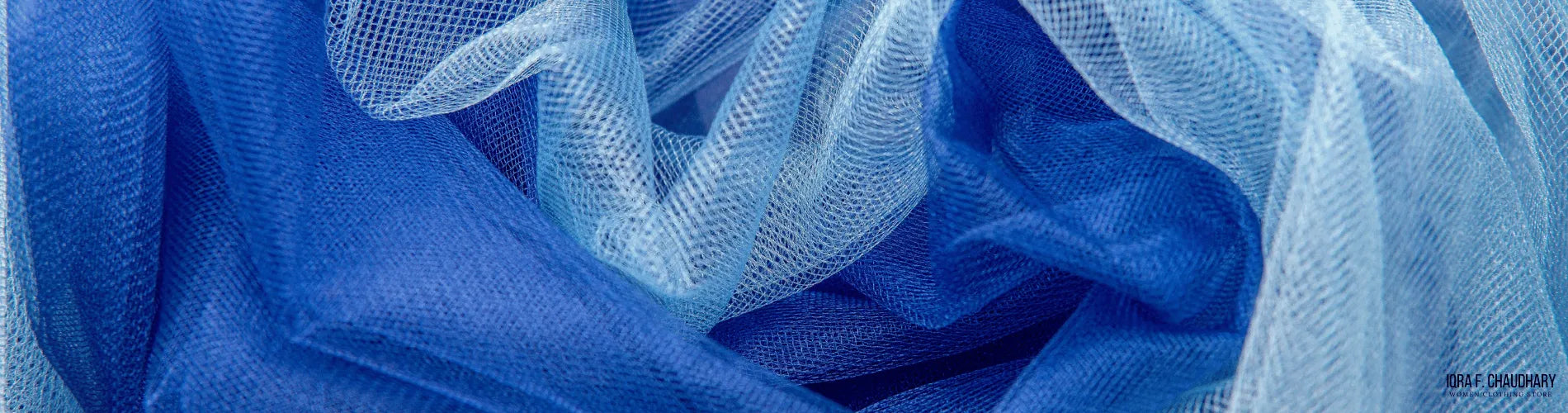
What Is Net Fabric? Types, History, Properties, Uses In Clothes
I treat net fabric as a full family of open textiles and explain what net is, which types exist from tulle to power net and zarri-net, and how its history moves from fishing tools to bridal lehengas. I describe how factories and artisans make net, how women’s clothing layers it over silk and lawn, and which physical and chemical properties matter most for strength and comfort.
I set out its pros and cons, then compare net with mesh fabric and tissue fabric so their roles stay clear. I give simple checks for spotting net, care rules that keep it safe, and then show how Iqra F. Chaudhry(women dresses desinger brand) uses cotton-net and zarri-net in bridal and formal outfits, which net dresses stand out, where her net sarees sit, and how net works across events and weather.
What Is Net Fabric?
Net fabric is an open textile where yarns cross and lock so regular gaps form between them. Those gaps create a grid or honeycomb of holes instead of a solid surface.
Net construction usually follows three points:
-
Intersections stay locked by knots, loops, or fused joints.
-
Openings range from tiny tulle holes to large fishnet diamonds.
-
Fibers include nylon, polyester, cotton, silk and blends.

In clothing, people use “net” as a structure word. You will hear cotton net, nylon net, zarri-net, power net and so on. The mesh look stays the same while fiber and finish change comfort, drape and care.
What Different Types of Net Fabric Are There?
The different types of net fabric include classic tulle, power net, fishnet, hexagonal netting, bobbinet, raschel and tricot nets, cotton-net, zarri-net and other embellished fashion nets.
It stays easier to understand if you group them by use.
-
Classic tulle
-
Fine, lightweight net with small hexagonal holes.
-
Common in bridal veils, ballet tutus, soft overlays on gowns and dupattas.
-
Power net / power mesh
-
Stretch net for lingerie, shapewear, sports bras and dancewear.
-
Built from elastane blends with good recovery and support.
-
Fishnet
-
Net with larger diamond openings and a clear visual pattern.
-
Used in hosiery, fashion layering and performance costumes.
-
Hexagonal netting and bobbinet
-
Machinery makes very fine hexagonal mesh with high strength and low weight.
-
Often used in couture veils, millinery and heritage dressmaking.
-
Raschel and tricot nets
-
Warp-knitted nets with controlled mesh sizes.
-
Used in sportswear, linings, shade structures, bags and technical products.
-
Cotton-net and cotton blends
-
Softer, more breathable nets.
-
Used in kaftans, phirans, dupattas and modest fashion where the net touches skin more.
-
Zarri-net and embellished fashion nets
-
Net bases with metallic yarns, sequins or embroidery.
-
Very common in South Asian sarees, lehengas, gowns and dupattas.
What is the History Of Net Fabric?
Net fabric history runs from ancient hunting and fishing tools to Mughal-era sarees and modern warp-knitted sports mesh. Many historians rank simple net structures among the earliest human textiles.
Key stages help keep the line clear.
-
Ancient use
-
Early communities made nets from grasses, vines and simple cords to trap fish and small animals.
-
Open structures allowed water and air through while holding the catch.
-
-
Early clothing and veils
-
Fine mesh starts to appear as veils, head coverings and trims in classical and medieval dress.
-
Court clothing in different cultures used net as a light outer layer.
-
-
South Asian fashion before and during Mughal periods
-
Records and visual sources show net sarees and net dupattas as part of festive and court wardrobes.
-
Net often supported metallic work, beads and stones in royal clothing.
-
-
Mechanical net machines in the 1800s
-
Before the nineteenth century, net meant hand work.
-
The bobbinet machine in the early 1800s changed that and allowed fine machine-made net and tulle.
-
Europe then used net foundations for embroidery, lace and veils on a large scale.
-
-
Modern warp-knitted net and mesh
-
Today most apparel and technical net comes from warp knitting lines and specialized weaving or extrusion.
-
Net now appears in fashion, sports, agriculture, packaging, medicine and many other fields.
-
How Net Fabric Is Made?
Net fabric is made by forming yarn intersections into locked loops, knots or fused joints so that regular holes remain between them. Modern factories use several methods for this, each with its own machines.
The main routes look like this:
-
Fiber and yarn choice
-
Nylon and polyester dominate when strength, abrasion resistance and low weight matter.
-
Cotton, silk and viscose nets cover softer, more breathable fashion lines.
-
Structure creation
-
Hand-knotting creates net by tying small knots at each intersection. This method still appears in craft nets and special pieces.
-
Woven nets use extra mesh and binding threads to create stable open spaces.
-
Warp-knitted nets (raschel and tricot) use parallel yarns and guide bars to build regular openings in the fabric.
-
Extruded plastic nets form when molten polymer passes through dies and stretches into a rigid open grid, mostly for packaging and agriculture.
-
Finishing and sizing
-
Some nets receive starch, resin or other sizing to keep shape and stiffness.
-
Others stay soft and elastic, like power net and lingerie mesh.
-
Dyeing, printing and coating for UV or flame resistance adjust the final performance.
-
Inspection and grading
-
Technicians measure mesh count, open area, yarn thickness, fabric weight, thickness and air permeability.
-
Those numbers decide where the net will go: saree, sports jersey, shade net or something else.
How Are Women’s Clothes Made From Net Fabric?
Women’s clothes made from net fabric treat net as an outer, semi-transparent skin over opaque bases or as panels in sleeves, necklines, dupattas and saree pallus. That approach lets designers keep modest coverage while net adds lightness, texture and space for embroidery.
Dressmakers follow a clear chain.
-
First, they decide the role of net: a full zarri-net lehenga, a net dupatta over silk kameez, a net cape over a maxi, or small tulle panels at the sleeves.
-
Second, they choose linings and bases such as raw silk, satin, lawn or karandi so the body stays covered while the net carries beads, stones or zari.
-
Third, they cut net in few layers at a time because stacked net slips. Sharp shears and careful notches keep shapes true.
-
Fourth, they sew with fine needles and small stitches. Rolled hems, picot edges or very neat overlocking protect the mesh from fraying.
What Are the Properties of Net Fabric?
The properties of net fabric come from its open structure. Net has high openness, low weight, variable stiffness and a strength-to-weight ratio that matters more than raw thickness. Physical properties describe what the net does under force, light, heat and moisture. Chemical properties describe how its fibers react with detergents, acids, alkalis, solvents, dyes and heat.
What Are The Physical Properties Of Net Fabric?
The physical properties of net fabric reflect both its mesh and its yarn.
Key points:
-
Low mass: fine tulle sits in the extra-light range; coarse nets still weigh less than many woven fabrics of similar thickness.
-
High openness: openings allow high airflow and low heat build-up, which explains why sportswear and shade structures use net and mesh.
-
Variable stiffness: manufacturers tune twist and sizing to move from very soft mesh to stiff petticoat nets.
-
Strength-to-weight: many nets carry high loads relative to their weight when tension spreads across the whole structure.
-
Fragility under snag: although strong in tension, net tears quickly if a sharp point catches a single strand. That tear often runs across the mesh.
-
Surface roughness: sheer fashion nets can feel slightly rough when layered over smooth satins, which matters for comfort and garment engineering.
What Are The Chemical Properties Of Net Fabric?
The chemical properties of net fabric follow the fiber, not the mesh structure.
-
Nylon nets
-
Good resistance to many washing detergents and weak alkalis.
-
Sensitive to strong mineral acids and some bleaches.
-
Gradual strength loss under long, direct sunlight.
-
-
Polyester nets
-
High strength and good resistance to many weak acids.
-
Sensitive to strong hot alkalis, which break ester bonds.
-
Thermoplastic behaviour: soften and melt rather than char at high ironing temperatures.
-
-
Cotton and silk nets
-
Cotton nets behave like other cellulosic fabrics: they dislike strong acids but tolerate moderate alkali better.
-
Silk nets behave like other protein fibers: they dislike strong acids, strong alkalis, high heat and harsh oxidising bleaches.
-
How Is Net Fabric Used?
Net fabric is used in women’s fashion, lingerie, sportswear, bridal wear, sarees, dupattas, veils, petticoats, bags, tents, shade structures, medical bandages, filters and agricultural covers.
In clothing you see it in:
-
Bridal and formal wear: net lehengas, zarri-net gowns, veils, capes and dupattas with heavy surface work.
-
Ethnic fashion: net sarees and net pallus, net sleeves and yokes, net dupattas layered over silk or lawn sets.
-
Lingerie and performance wear: power net for bras, shapewear, dance costumes and gymnastics outfits.
-
Casual and sports: jerseys, mesh panels in jackets and hoodies, backpack pockets and sneakers.
Where Is Net Fabric Produced?
Net fabric is produced in most large textile regions. Warp-knitted and woven nets concentrate in China, India, Pakistan, Turkey and similar hubs, while Europe and North America hold many technical mesh and lingerie net producers.
Broad patterns look like this:
-
China and India lead in synthetic net and tulle for apparel, décor and industrial use.
-
Indian craft regions specialise in zari-rich fashion nets for sarees, lehengas and bridal sets.
-
Pakistan, Turkey and other exporters supply cotton-net, sports mesh and home textiles.
-
Specialised mills in Europe and North America focus on high-end lingerie bobbinet, filtration nets and sports mesh.
What Are the Pros and Cons of Net Fabric?
The pros and cons of net fabric balance its lightness, airflow and visual drama against fragility, limited coverage and careful care. Designers rely on net for height and sparkle, but accept that snags and tears rarely hide.
This table sets the main strengths and weaknesses side by side.
| Aspect | Pros of net fabric | Cons of net fabric |
|---|---|---|
| Weight and airflow | Very light and breathable, useful in hot climates, sportswear and shade structures. | Low insulation; feels cold in winter without strong linings and layers. |
| Structure and drape | Adds fullness in lehengas, petticoats and veils without heavy bulk. | Fragile around holes; pulled threads and tears are hard to repair invisibly. |
| Appearance | Transparent mesh lets embroidery, beads and zari appear as if they float over the body. | Transparency demands careful lining and pattern planning for modesty and neat construction. |
| Comfort | Open structure allows ventilation; cotton-net and soft tulle feel gentle as outer layers. | Coarse or stiff net can scratch at neck, armhole or waist; some synthetic nets feel harsh on sensitive skin. |
| Durability and care | Synthetic nets show good chemical resistance and strength for the weight when handled gently. | Net garments need delicate washing or dry cleaning; snagging on jewellery or rough surfaces is common. |
| Cost and range | Wide price ladder from low-cost polyester net to premium cotton or silk bobbinet and zarri-net. | High-grade bobbinet and heavily embellished net outfits sit in the luxury bracket. |
What are the difference betweem Net vs Mesh Fabric?
Net vs mesh fabric often turns into a naming question. Many people use both words for similar structures, yet there is a loose pattern in how industry uses them.
You can summarise the differences like this:
| Aspect | Net fabric | Mesh fabric |
|---|---|---|
| Definition | Open textile where yarns intersect as knots, loops or fused joints, often with decorative roles. | Open textile with regular, measured holes, often defined by mesh count and open area. |
| Construction | Hand-knotted, woven, warp-knitted or extruded; geometry may be square, hexagonal or diamond. | Mostly warp-knitted or woven with consistent, engineering-led patterns. |
| Main use in fashion | Veils, sarees, dupattas, bridal gowns, lehengas, capes and sleeves. | Sports jerseys, sneakers, backpack pockets, technical panels and performance tees. |
| Common language | Fashion retail often says net dupatta, net saree, zarri-net lehenga. | Sports and technical sectors prefer the word mesh. |
What are the difference between Net vs Tissue Fabric?
Net vs tissue fabric compares a mesh with visible holes to a thin, transparent but more continuous cloth often mixed with metallic yarns. Both sit in the sheer, formal family, but they behave differently.
This table keeps the difference clear.
| Aspect | Net fabric | Tissue fabric |
|---|---|---|
| Structure | Open mesh with visible holes; yarns lock at points. | Thin, transparent fabric with a continuous surface, usually a plain weave. |
| Fiber focus | Nylon, polyester, cotton, silk and blends. | Silk, man-made fibers and metallic yarns such as zari. |
| Visual effect | Strong pattern of holes; embroidery often appears to float in space. | Smooth shimmer and film-like shine without visible holes. |
| Typical garments | Net sarees, dupattas, lehengas, veils, capes and statement sleeves. | Tissue sarees, tissue silk gowns, borders and panels in formal outfits. |
| Hand and care | Snags easily and needs gentle cleaning and storage. | Metallic yarns need protection from crushing and harsh detergents. |
How To Recognize Net Fabric
To recognize net fabric you look for a textile where the gaps are part of the design, not damage. Yarns cross and lock, but empty space still covers much of the surface.
A quick practical method:
-
Hold it up to light
-
You should see a clear, repeated pattern of holes.
-
-
Look at the intersections
-
On some nets you see tiny knots.
-
On warp-knitted nets you see loops running in diagonal paths.
-
-
Feel and move it
-
When you shake it, the fabric moves a lot of air compared with a solid weave.
-
It may feel crisp (stiff net) or soft (power mesh), but the gaps always stay obvious.
-
-
Compare with a known swatch
-
Keeping one sample of bridal net, one sample of cotton-net and one power mesh swatch in a studio gives instant reference.
-
How to Care for Net Fabric
To care for net fabric you limit mechanical stress, keep it away from sharp accessories, use mild detergents, low heat and gentle drying, and choose dry cleaning for heavily embellished or sized pieces.
Key steps:
-
Always read the care label and note the fiber and level of embroidery or stones.
-
For bridal and formal net with heavy work, prefer professional dry cleaning to protect sizing and embellishment.
-
For simple synthetic mesh, use delicate machine cycles in a mesh bag, cool water and mild detergent.
-
Do not wring; press water out between towels and dry flat or on padded hangers.
-
Iron with low heat and a press cloth, testing on a hidden corner first.
-
Store net garments in garment bags or folded with tissue between layers to avoid snags and hard creases.
How Do You Know Genuine Net Fabric Is Used in Women’s Clothes?
To know genuine net fabric is used in women’s clothes you confirm the label, inspect the structure and check how the brand describes its fabric.
A simple checklist:
-
Read product details for clear terms such as net, cotton-net, zarri-net, power net or mesh, not only “fancy fabric.”
-
Hold the garment to light and look for real holes in a stable pattern, not just a thin tissue or chiffon.
-
Feel if the fabric behaves like a frame, with more air between yarns than in standard sheers.
-
For high budgets, ask for a fabric swatch or clear fiber breakdown. Brands that invest in zarri-net, cotton-net or silk tulle usually share that information.
-
In rare disputes a textile lab can confirm both fiber and structure.
How Does Iqra F. Chaudhry Make Women’s Dresses Through Net Fabric?
Iqra F. Chaudhry makes women’s dresses through net fabric by using cotton-net, zarri-net and other fashion nets as outer layers for sarees, lehengas, dupattas and kaftans, while raw silk and other opaque bases hold coverage and comfort.
Across current lines you see the same pattern:
-
Bridal and formal zarri-net sets use metallic net for tops, lehengas and dupattas while inner layers stay in raw silk or similar bases.
-
Net bridal outfits layer full net gowns and lehengas with net dupattas and dense handwork for high-ceremony events.
-
Zarri-net sarees use net as the entire saree body, so the pallu and pleats show shimmer and embroidery in one fabric story.
-
Semi-formal sets combine zarri-net shirts and dupattas with raw silk trousers so the wearer gets both structure and ease.
-
Cotton-net kaftans use softer net for modest, relaxed silhouettes with more everyday comfort.
What Are the Best Net Fabric Dresses for Women?
The best net fabric dresses for women inside Iqra F. Chaudhry use net for presence but rely on smart layering for ease.
-
Net bridal sets
-
Full net base for gown, lehenga and dupatta with dense handwork.
-
Aim at main wedding events where the outfit must carry heavy embellishment and stay photogenic.
-
-
Zarri-net formal ensembles
-
Gold-toned zarri-net tops with matching net dupattas and raw silk lowers.
-
Work well for receptions, Walima events and high-level dinners.
-
-
Zarri-net sarees
-
Net sarees with metallic effect yarns, lighter than many traditional brocades.
-
Give a modern, airy saree look that still reads as formal.
-
-
Net shirt and dupatta sets
-
Net shirts and dupattas over raw silk or similar trousers.
-
Allow the wearer to reuse pieces as guest outfits in many events.
-
-
Cotton-net kaftans
-
Kaftan cuts in cotton-net that combine coverage with ventilation.
-
Fit evening gatherings, Eid visits and home entertaining where comfort matters.
-
-
Outfits with net-accent dupattas
-
Solid cores in silk or lawn with net or sheesha-net dupattas.
-
Let the wearer enjoy net near the face and shoulders without wearing it across the whole body.
-
These directions show net as a flexible tool rather than a single-purpose bridal fabric.
Does Iqra F. Chaudhry Have Net Fabric Sarees?
Iqra F. Chaudhry offers net-based sarees through zarri-net designs where net forms the main saree fabric. Those sarees rely on net to shape the pallu, frame embroidery and keep weight manageable while the blouse and petticoat control coverage.
Net sarees from other designers in the same retail ecosystem sit nearby, but the in-house zarri-net saree gives a clear example of how the label reads net in a saree format.
Is Net Fabric Suitable for Different Occasions or Seasons?
Net fabric is suitable for different occasions and seasons when fiber, lining and styling match the climate and the event.
For occasions, net fits best in weddings, receptions, Nikkah, Walima, Eid gatherings and formal dinners where structure, volume and surface work matter. It feels too dressy for most office or everyday settings unless used only as a small accent.
For seasons, cotton-net and light tulle over breathable bases suit spring and warm evenings, while heavier nylon or polyester nets with full linings feel better in cooler months or fully air-conditioned venues.
So net does not belong to one fixed season. It belongs to a combination of fiber choice, layering and event type that respects both weather and dress code.
