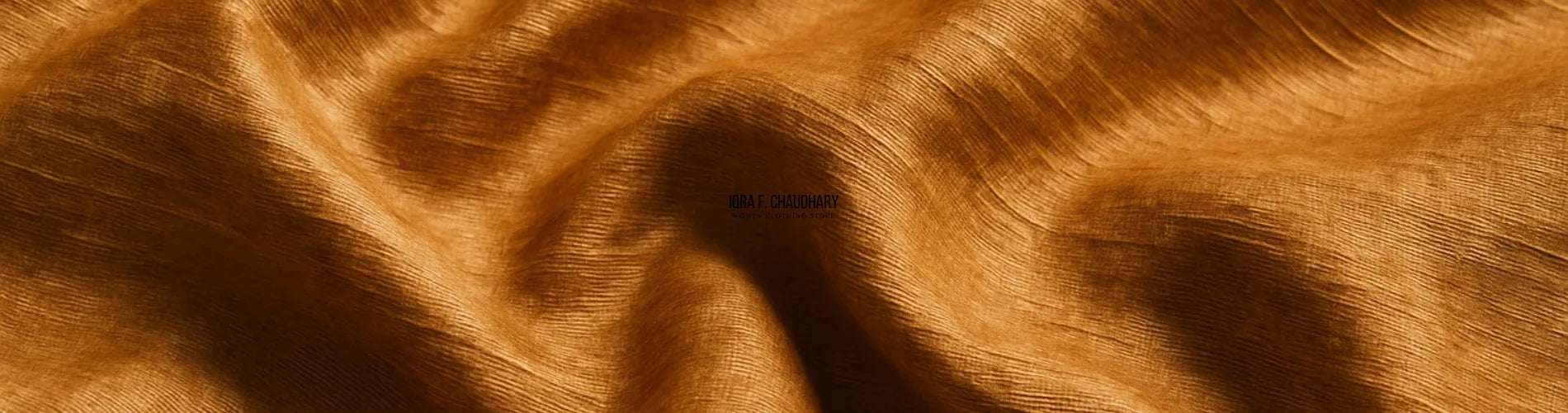
What Is Tussar Silk Fabric? Types, History, Properties, Uses In Clothes
Tussar silk is a wild silk fibre from forest silkworms, and tussar silk fabric is the textured, golden cloth woven from those yarns for sarees, suits and kaftans. I explain how tussar fits inside the vanya, or wild, silk family, set out its main types, and trace its history from forest-based sericulture in India and Asia to today’s handloom and designer use.
I walk through physical and chemical properties, pros and cons, and tables that compare tussar with mulberry raw silk and 80 g raw silk so the differences stay clear. I show how to recognise genuine tussar, how to care for it at home or by dry cleaning, and how Iqra F. Chaudhry places tussar in her women’s dresses, with short notes on the best tussar pieces and how they suit different events and weather.
What Is Tussar Silk Fabric?
Tussar silk fabric is a coarse, textured silk cloth woven from wild silk fibres produced by Antheraea silkworms that live on forest trees rather than mulberry plants. As a material it is known for a natural beige-to-gold base colour, irregular slubs and a dry, earthy handle that differs from the smoother feel of mulberry silk.
These wild fibres form part of the “vanya” or wild silk group in India, which includes tasar, eri and muga silks and makes up a significant share of non-mulberry production. Fabrics woven from tussar silk are used for sarees, suits, kaftans, shawls and dupattas where designers want both texture and a heritage link with forest-based sericulture.
What are the Different Types of Tussar Silk Fabric?
The different types of tussar silk fabric are grouped by silkworm ecology, by trade style and by yarn or weave.
-
By ecology and species
-
Tropical tasar from Antheraea mylitta and related ecoraces, reared in central and eastern India on Terminalia and Shorea trees.
-
Temperate or oak tasar from Antheraea proylei and similar species that feed on oak at higher altitudes.
-
-
By commercial category
-
Wild tussar and desi tussar, where brands distinguish more rustic, heavily textured cloth from finer, slightly shinier versions reared in controlled forest belts.
-
Tussar blends such as tussar–cotton or tussar–wool, used for shawls, jackets and winter accessories.
-
-
By yarn and weave
-
Pure tussar plain weaves for sarees and suits.
-
Ghicha tussar, where yarns spun from waste or short fibres give a more irregular look.
-
Tussar cross-constructions such as tussar–katan mixes used for heavier bridal or occasion wear.
-
What is the History Of Tussar Silk Fabric?
The history of tussar silk fabric traces the growth of wild silk culture, especially in the Indian subcontinent, where tasar and tussar silks hold economic and cultural weight.

-
Zoological work identifies Antheraea paphia (often referred to under the older name Antheraea mylitta) as a key tropical tasar silkworm, with at least dozens of ecoraces adapted to different host trees and climates.
-
Historical and textile studies classify tussar among major wild silks alongside eri and muga, produced mainly in India and China, with India standing out for the range of vanya silks.
-
Statistical work on Indian silk shows tasar raw silk production averaging around 583 metric tons between 1951 and 2019, with growth rates near 4.7 percent per year during that period, which signals a steady increase in wild silk importance even while mulberry remains larger in volume.
-
Recent reports place India as the world’s largest producer of tropical tasar silk, with Jharkhand leading state output and hundreds of thousands of rural and tribal households involved in tasar sericulture and related work.
How Tussar Silk Fabric is Made?
Tussar silk fabric is made by rearing wild silkworms on forest or plantation trees, reeling their cocoons, and weaving the resulting yarns into textured cloth.
Key stages line up as follows:
-
Silkworm rearing in forests or semi-wild settings
-
Antheraea larvae feed on trees such as Terminalia arjuna, Terminalia tomentosa and Shorea robusta rather than on mulberry bushes.
-
-
Cocoon harvest and sorting
-
Farmers collect cocoons from host trees and sort them by size and quality; Central Silk Board technologies can now grade tens of thousands of tasar cocoons per hour with high accuracy.
-
-
Cooking and reeling
-
Cocoons are cooked in water, often with chemicals for wild silks, to swell and soften sericin so that the filament unwinds with fewer breaks.
-
Reeling methods include dry and wet techniques; research shows wet-reeled tasar gives yarns with better strength, cohesion and lustre, used as warp yarns in place of imported Korean or Chinese raw silk.
-
-
Spinning, weaving and finishing
-
Filaments may be reeled directly or spun from shorter fibres and wastes, then woven into saree lengths, dress fabrics or shawls.
-
Finishing steps adjust handle and sheen while keeping the characteristic texture that shoppers expect from tussar.
-
How from Tussar Silk Fabric Women Clothes were Made?
Women’s clothes made from tussar silk fabric use its textured body and natural colour for sarees, suits, kaftans, jackets and dupattas that look formal yet grounded.
In Indian and regional markets, fashion writing and brand content describe tussar as a base for:
-
Sarees with hand painting, block prints or embroidery, where the grainy surface frames the artwork.
-
Dress materials and salwar-kurta sets, including blends with cotton for bafta-type fabrics.
-
Jackets, shawls and scarves, especially when designers want a slightly firm fabric that still drapes.
What are the Properties of Tussar Silk Fabric?
The properties of tussar silk fabric arise from its wild silk fibroin and sericin, its relatively large fibre diameter and its less uniform structure compared with mulberry silk.
Broadly, tussar fibres share high tensile strength, moderate elongation, good resilience and biodegradability with other silks, yet they show coarser texture, lower gloss and a distinctive microstructure that research links to slightly different crystallinity levels. Physical properties describe how the fabric looks, drapes, insulates and resists force. Chemical properties describe fibroin–sericin composition, amino acids and reactions to water, heat, acids and alkalis.
What are the Physical Properties of Tussar Silk Fabric?
The physical properties of tussar silk fabric explain its firm yet breathable behaviour in sarees and suits.
Findings from silk property studies and comparisons between mulberry and tasar yarns show that:
-
Tussar silk counts as a strong natural fibre, with tenacity somewhat lower than mulberry silk but still in a several grams-per-denier range that suits warp use once processing is tuned.
-
Tasar and other wild silks have striated surfaces and larger average fibre diameters, which contribute to a rougher, more textured handle than smooth mulberry silk.
-
Studies comparing mulberry and tasar yarns report that mulberry yarn tends to higher tenacity and lower flexural rigidity, while tasar yarn shows slightly lower tenacity and different elongation behaviour, which fits the firmer feel in fabric.
-
Thermal and comfort work on silk fibres as a group describes good moisture regain and thermoregulation, with silk stable up to around 140 °C and used in contexts where “warm in winter, cool in summer” comfort is valued – a description often applied to vanya silks including tasar.
-
Tussar’s natural beige-to-gold shade and irregular slubs give strong surface interest even before dyeing or printing.
What are the Chemical Properties of Tussar Silk Fabric?
The chemical properties of tussar silk fabric sit within the same protein framework as other silks but with nuances linked to wild species.
Research on silk composition and fibroin–sericin systems shows that:
-
Raw silk fibres contain roughly 70–80 percent fibroin and 20–30 percent sericin, plus small amounts of waxes, pigments, minerals and carbohydrates.
-
Fibroin, the structural core, is a polypeptide rich in glycine and alanine, forming beta-sheet crystals that give silk its strength and relatively high crystallinity, with reported values around 40–50 percent for silkworm fibroin.
-
Sericin, the outer gum, is more hydrophilic, with high levels of serine and aspartic acid, and dissolves more readily in hot water or alkaline solutions.
-
Wild silks such as tasar show microstructural differences from mulberry, including slightly different crystallite sizes and orientation; X-ray studies report tasar crystallinity values close to but not identical with mulberry fibroin.
How Is Tussar Silk Fabric Used?
Tussar silk fabric is used in sarees, dress materials, jackets, dupattas, shawls and lehenga sets where designers want both structure and an organic look.
Fashion and craft sources describe typical use cases such as:
-
Handloom tussar sarees with prints, hand painting, zari borders or kantha work that play against the natural ground.
-
Salwar-kurta materials, bafta-type blends and jackets that rely on tussar’s moderate stiffness and strength.
-
Shawls, stoles and mufflers, sometimes in blends with wool or other fibres for winter use.
Where Is Tussar Silk Fabric Produced?
Tussar silk fabric is produced in several Asian countries, with India as the leading centre for tropical tasar silk and an important player in oak or temperate tasar.
-
Encyclopaedic and fashion sources list China, India, Japan and Sri Lanka among producers of tussar silk, with different Antheraea species linked to different regions.
-
Government and academic reports describe India as the world’s largest producer of tropical tasar, concentrated in states such as Jharkhand, Chhattisgarh, Odisha and Bihar, with smaller contributions from Maharashtra, West Bengal and Andhra Pradesh.
-
Vanya silk (tusar, eri, muga) shows double-digit growth in some recent years, contributing to a wider raw silk total that reached around 38,913 metric tons in India in 2023–24, even though mulberry still holds most of that volume.

What Are the Pros and Cons of Tussar Silk Fabric?
The pros and cons of tussar silk fabric balance texture, heritage and comfort on one side with care needs, price and roughness on the other.
| Aspect | Pros of tussar silk fabric | Cons of tussar silk fabric |
|---|---|---|
| Look and texture | Natural beige-to-gold colour with visible slubs and a distinctive wild-silk grain that many people see as rich and earthy. | Coarser handle than mulberry silk; some wearers with very sensitive skin may prefer smoother fabrics. |
| Structure and drape | Moderate stiffness with enough drape for sarees and suits; surface carries prints, paints and embroidery clearly. | Less fluid than chiffon or soft mulberry satin; not ideal for garments that need liquid flow or heavy bias cuts. |
| Strength and durability | Strong wild silk; tasar yarns hold up in warp after suitable processing, and wild silks are used in technical and biomedical work because of strength and stability. | Yarn irregularities and thick–thin zones give higher risk of isolated weak spots, which requires careful grading and weaving. |
| Comfort and climate | Breathable structure with good moisture management; vanya silk descriptions emphasise “warm in winter, cool in summer” behaviour in daily wear. | Heavier, rougher weaves may feel warm in very humid heat unless cuts and linings stay airy. |
| Cultural and ethical angle | Strong cultural heritage in eastern and central India and links with rural livelihoods and tribal communities. | Wild silk rearing still raises questions about forest use and insect life; some buyers look for peace-silk or alternative sources. |
What is the Difference Between Tussar Silk Fabric vs Raw Silk Fabric?
The difference between tussar silk fabric and raw silk fabric is that tussar comes from wild Antheraea silkworms, while raw silk usually means undegummed mulberry silk from Bombyx mori; tussar is coarser and more golden, raw silk smoother and more neutral in colour.
| Aspect | Tussar silk fabric | Raw silk fabric (mulberry) |
|---|---|---|
| Silkworm and ecology | Produced by wild Antheraea species living on forest trees such as Terminalia and Shorea. | Produced by domesticated Bombyx mori silkworms reared on mulberry leaves. |
| Surface and handle | Textured with strong slubs, natural golden tone and a dry, rustic hand. | Smoother filament, fine slubs only, off-white or pale yellow base and a softer feel, even before full degumming. |
| Mechanical behaviour | Good strength with slightly different tenacity–elongation balance and higher flexural rigidity than mulberry yarns. | Higher tenacity and lower flexural rigidity on average, which gives smoother drape. |
| Typical garments | Sarees, ethnic suits, jackets, shawls where texture and heritage are central. | 80 g raw silk suits, gowns, phirans and bridal pieces where a smoother yet structured look is needed. |
What is the Difference Between Tussar Silk Fabric vs 80g Raw Silk Fabric?
The difference between tussar silk fabric and 80 g raw silk fabric is that tussar uses wild silk with a more irregular, golden texture, while 80 g raw silk is a specific weight of mulberry raw silk plain weave used in South Asian formalwear for a smoother, more uniform face.
| Aspect | Tussar silk fabric | 80 g raw silk fabric |
|---|---|---|
| Fibre base | Wild Antheraea silks. | Mulberry Bombyx mori silk. |
| Weight and weave | Wide range; often medium to heavy weights in handloom sarees and suits, with visibly slubby yarns. | Plain-weave silk around 80 g per metre used in many Pakistani and regional formals, described explicitly on product pages. |
| Surface look | Earthy, golden base, strong visual slubs and slight dryness. | More regular, with gentle sheen and finer slubs; takes heavy embroidery in clean lines. |
| Typical role in outfits | Sarees, kaftans, shawls where texture is the focus. | Shirts, phirans and trousers in formal and bridal outfits where structure and polish are needed. |
How To Recognize Tussar Silk Fabric?
To recognize tussar silk fabric you check surface, colour, handle and documentation together.
Useful markers:
-
Natural colour and slubs – look for a beige-to-gold base even under dye and for pronounced, irregular slubs across both warp and weft.
-
Wild-silk grain – under magnification or close inspection, wild silks such as tasar show more striations and surface irregularity than mulberry.
-
Handle and drape – fabric feels firm and slightly dry, bending with more resistance than soft mulberry satin but still draping enough for sarees.
-
Labels and origin notes – better handloom and designer pieces write “tussar silk”, “tasar” or “vanya silk” on tags, often with state or cluster names from eastern India.
-
Price positioning – pure tussar generally sits between mid-range blends and high-end mulberry formals of similar design, reflecting both fibre value and handwork.
How to Care for Tussar Silk Fabric
To care for tussar silk fabric you protect its protein structure and surface texture from aggression by harsh chemicals, high heat and abrasion.
Guidelines that align with silk-care research and tasar processing practice:
-
Prefer professional dry cleaning for heavily embroidered or structured garments, especially sarees and designer sets.
-
When hand washing is permitted, use cool water with a mild detergent suitable for silk; avoid strong alkaline powders.
-
Move the fabric gently, do not wring; roll in a towel to remove excess water.
-
Dry flat or on a padded hanger in shade; direct strong sunlight speeds colour fading and fibre ageing.
-
Use a low-heat iron on the reverse with a press cloth, or steam lightly from a short distance so that slubs and texture stay visible.
-
Store in breathable covers, folded rather than hung for very heavy pieces, and keep away from moisture and insect exposure.
How do you know genuine Tussar Silk fabric is used in women clothes?
To know genuine tussar silk fabric is used in women’s clothes you combine fabric labelling, look-and-feel checks and source credibility.
In practice shoppers tend to:
-
Read fibre notes; clear mentions of “Tussar silk” or “Tasar silk” on product pages and tags signal intent to use that fibre, not a generic blend.
-
Check surface and colour for the expected golden slubs rather than a very smooth, pure-white base.
-
Cross-check whether the brand speaks about vanya or forest-linked silk in its storytelling, which supports the tussar claim.
-
Look at price and positioning; pure tussar sets usually occupy a higher tier than cotton or synthetic suiting but may sit beside or just under formal mulberry silks.
How Iqra F. Chaudhry Make Women Dresses Through Tussar Silk Fabric?
Iqra F. Chaudhry makes women’s dresses through tussar silk fabric by using it as a textured base for polished kaftan sets and occasion pieces.
Current material on her site shows:
-
Nerissa, a two-piece outfit described as a blue tussar silk set with beige embroidery, cut as a boxy kaftan for a clean, midi-length line.
-
Blog coverage of kaftans that names Nerissa’s tussar silk shape as one of the best midi kaftan dresses, framed with other pieces on organza and raw silk.
-
Wider styling on social channels that pairs tussar silk sets and dupattas with raw silk trousers for Eid and wedding looks, keeping tussar in the areas where texture and drape need to show at distance.
What are the Best Tussar Silk Fabric Dresses for Women?
The best tussar silk fabric dresses for women in this brand universe are the pieces that use tussar’s grain and strength in simple cuts with focused embroidery. From current and recent content:
-
Nerissa – a boxy tussar silk kaftan set with beige embroidery, styled as a midi outfit for day or evening.
-
Amerie-type Eid sets and similar drops – tussar silk sets with sheer dupattas highlighted in Eid edit posts, aimed at festive but wearable looks.
-
Tussar dupatta–raw silk base pairings – outfits where a sheer or semi-sheer tussar silk dupatta tops an 80 g raw silk sharara or kurta, combining structure and texture.
Is Tussar Silk for Different Occasions or Seasons?
Tussar silk is for different occasions and seasons when designers adjust weight, lining and styling to suit climate and dress code.
-
For occasions, tussar is widely used in sarees, kaftans and suits for festivals, weddings, receptions and formal gatherings, where its natural sheen and texture match jewellery and handwork.
-
For seasons, vanya silk descriptions stress comfortable thermal behaviour; many craft sources describe tussar garments as warm in winter and relatively cool in summer, especially in looser, breathable silhouettes.
